From Idea to Operating Business: How Solo Runs ListMyCar.ai
How Solo turns strategy into supervised work, operates ListMyCar.ai with the tools its team chooses, and carries verified lessons forward.
AI can turn an idea into a demo. A business has to keep shipping, find customers, learn from what they do, and recover when production breaks.
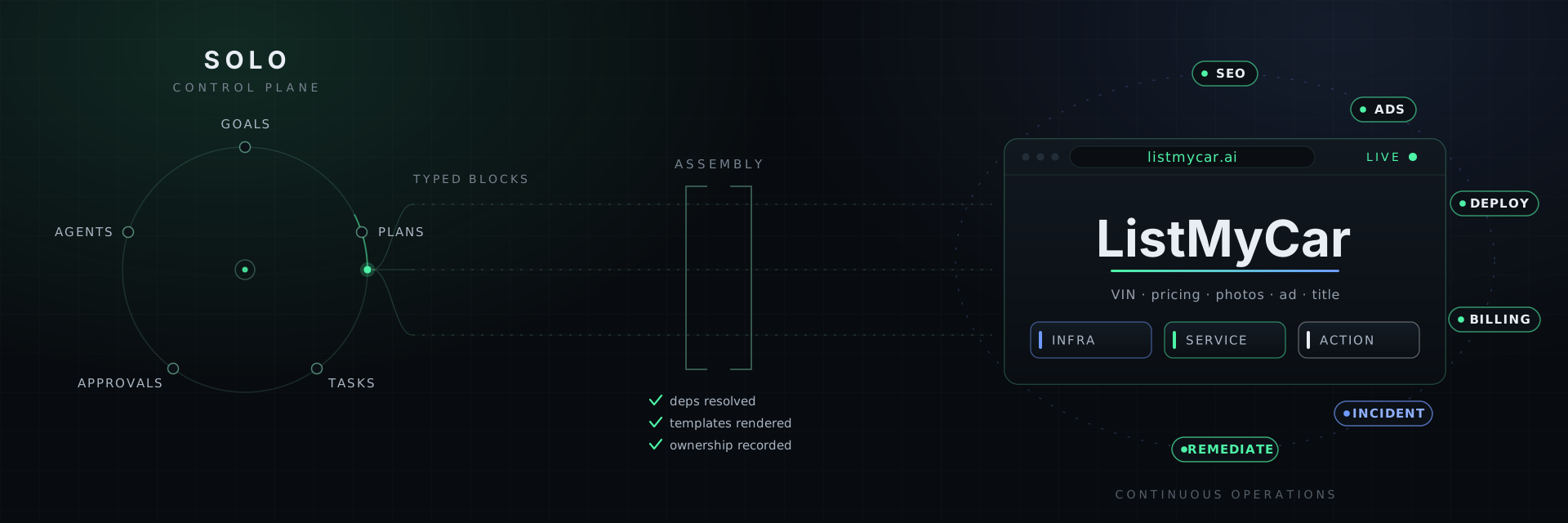
Solo is a business operating system for founders and small teams. It turns an owner's strategy into goals, daily work, and recurring operations. Routine work can keep moving automatically, while consequential actions wait at supervised gates. When something fails, Solo records what happened so the next run starts with that context.
ListMyCar.ai is where we tested that model. The product helps private sellers turn a VIN and a set of photos into a complete car listing, with pricing guidance, stronger images, marketplace-ready copy, and supporting paperwork.
From April through August 2026, more than 50 people created a listing. That adoption matters. So does the system behind it: an idea became a live business without locking its code, infrastructure, or development process to Solo.
Start with a foundation you own
The first ListMyCar repository came from an early Solo scaffold. It included a working frontend, API, database with migrations, authentication, billing integration, and a local development environment. Solo also selected a production architecture appropriate for the business and packaged its AWS CDK definition with the repository.
The CDK definition keeps the infrastructure portable. ListMyCar runs on infrastructure defined in its own repository, and the business can deploy it into its own AWS account. The production architecture belongs to the business, just like the application code.
That was not the product. It was a conventional Git repository with the foundational systems already connected, so the team could spend its next hour on the customer problem instead of project setup.
The application code stayed editable, and Solo-managed modules remained separate. The team got a faster start without giving up control of its repository.
Build with Solo or the tools you choose
ListMyCar used a hybrid model because the best tool varies by job.
Claude Code built product features and marketing assets. Working in the same repository, it contributed VIN decoding, the listing flow, photo enhancement, price suggestions, public listing pages, marketplace export kits, and search-focused content.
Solo can build the product alongside your team and tools while it helps run the business. The owner's vision becomes goals, reviewed plans, and tasks. Builders work in isolated workspaces, and every change must pass repository checks and an independent review. Accepted work then follows the same path through staging, production release, verification, and rollback.
Whether a change comes from a developer, Claude Code, or Solo, it lands in the same repository and follows the same delivery path. Teams can use Solo for the whole build or keep the tools they already prefer.
ListMyCar also keeps its own delivery path. Its GitHub repository deploys to its AWS infrastructure through GitHub Actions. Solo dispatches that existing workflow, follows the exact commit being released, reads the release record, and verifies the result. Solo coordinates the release and records what happened without taking over the infrastructure.
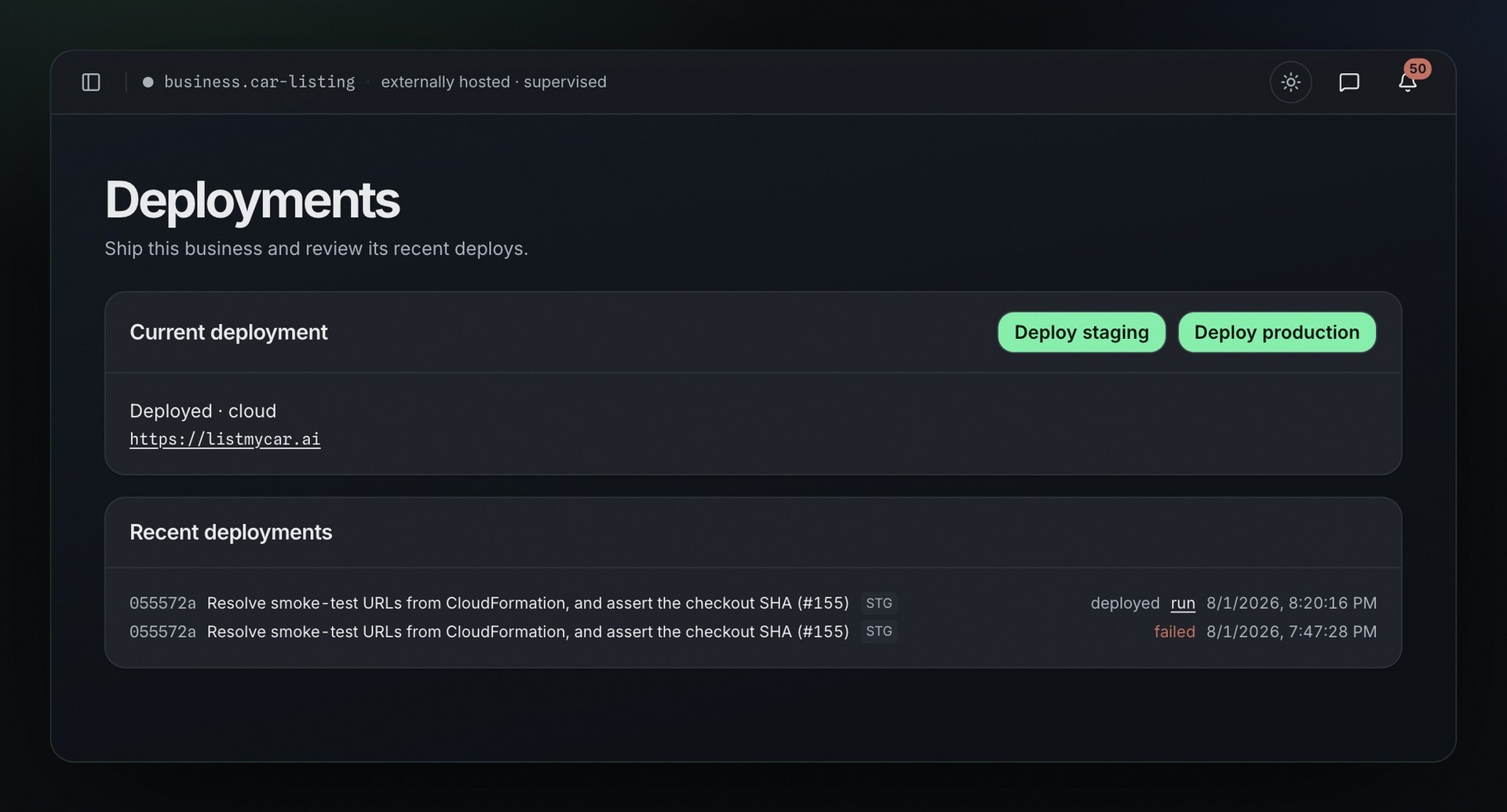 A failed attempt remains visible beside the successful deployment, preserving the full operating record.
Turn strategy into supervised work
Automation only helps when it follows the owner's priorities. Solo connects those priorities to work that can move the business forward.
- Set direction. The owner defines the vision, goals, constraints, and non-goals.
- Read current evidence. Solo brings together active work, product analytics, search demand, campaign data, deployments, and incidents.
- Suggest the next move. Daily Grow suggestions use current metrics and avoid proposing work that is already underway.
- Turn a choice into a plan. An accepted suggestion or owner-created goal becomes an ordered task plan. A separate reviewer checks it before the owner approves execution.
- Run within boundaries. Routine work continues on schedule. Publishing, campaign activation, production deployment, and destructive changes stop at supervised gates pending human approval.
Grow identifies new opportunities from current evidence. Each morning, the plan turns approved goals and active commitments into priorities and task proposals.
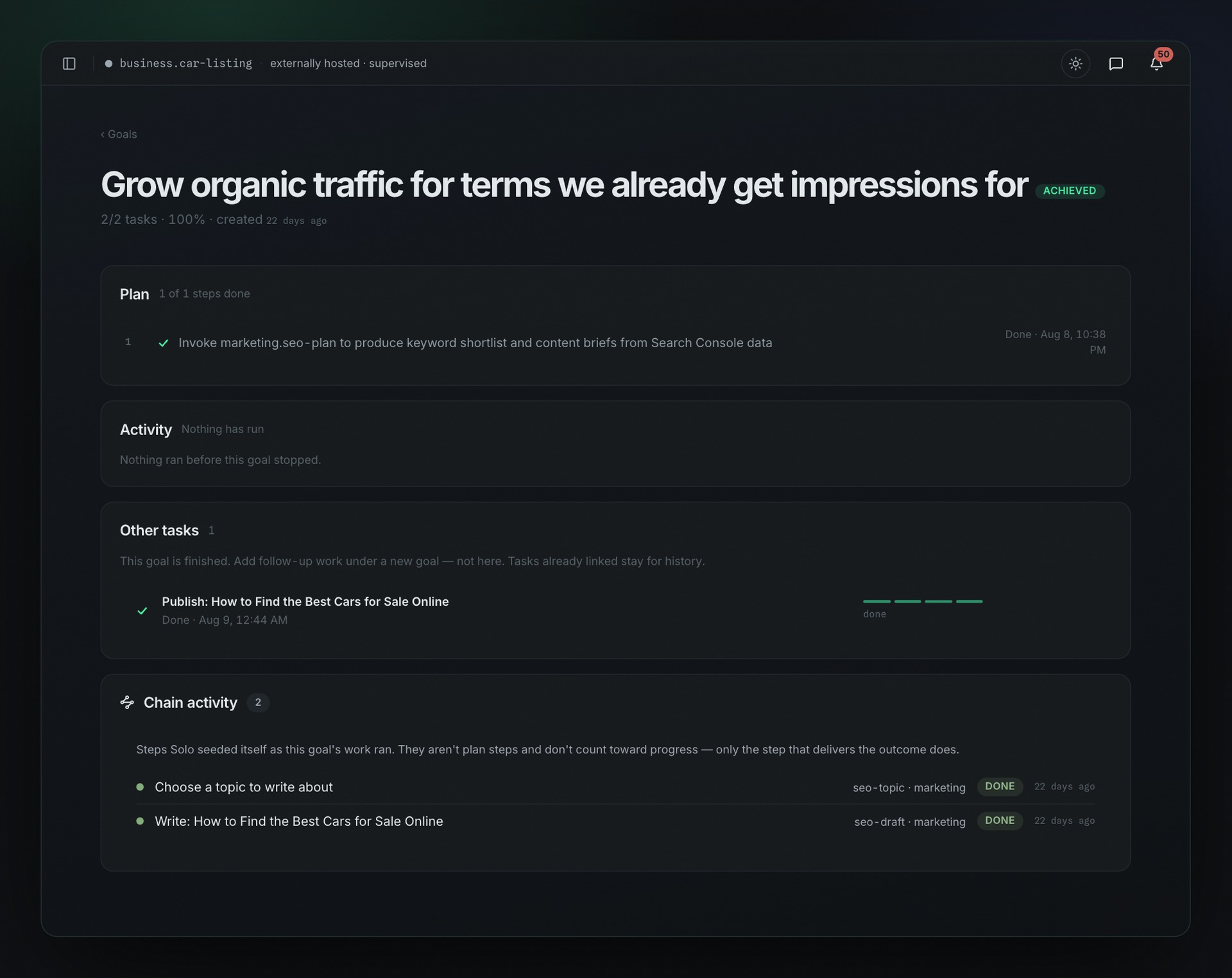 One goal end to end: the plan step, the task that delivered it, and the chain steps Solo seeded itself as the work ran. Progress, pauses, and failures all stay part of the record.
The owner's job: set direction, choose goals, talk to customers, and approve consequential decisions.
Solo's job: track what is happening, propose the next move, plan and run the work, verify the outcome, and carry useful lessons forward.
Run four business loops
ListMyCar became an operating business by adding four loops around the product.
Ship. A commit moves through checks, staging, migrations, production, and smoke tests. Solo records exactly which commit is running.
Measure. Product events follow the customer journey from account creation and VIN decoding through listing completion, marketplace export, public listing views, and buyer contact. Solo also tracks API errors and latency, frontend failures, and database pressure.
Recover. When something fails, Solo opens an incident with the release context and failed logs. A coding agent can prepare a fix, but it still has to pass the normal checks and deployment path. Infrastructure and workflow files remain protected.
Grow. ListMyCar uses structured pages, metadata, schema markup, sitemaps, crawl controls, search indexing, and attribution. Solo can turn measured search demand into a proposed topic and draft for publication approval, or prepare an ad campaign in a paused state. Publication and campaign activation still require approval.
Early evidence from April through August
The snapshots below cover ListMyCar's activity from April through August 2026.
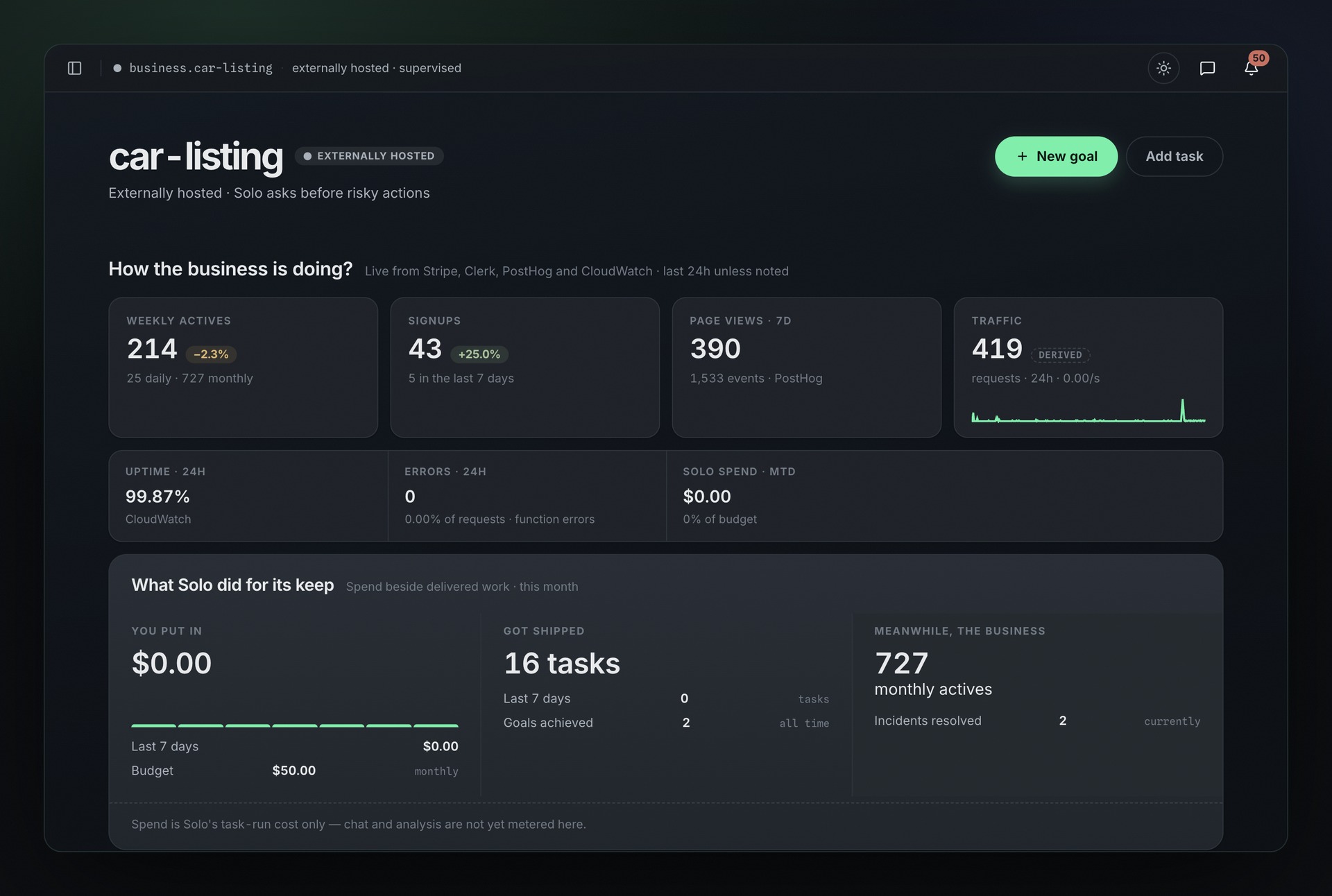 The operator's own view of the business, read live from Clerk, PostHog, and CloudWatch. Solo puts what it spent beside what it delivered.
Across that period, the site recorded 2,048 sessions and 956 engaged sessions, a 46.7% engagement rate. Traffic included 601 direct sessions, 556 from organic search, 380 from paid search, and 187 from AI assistants.
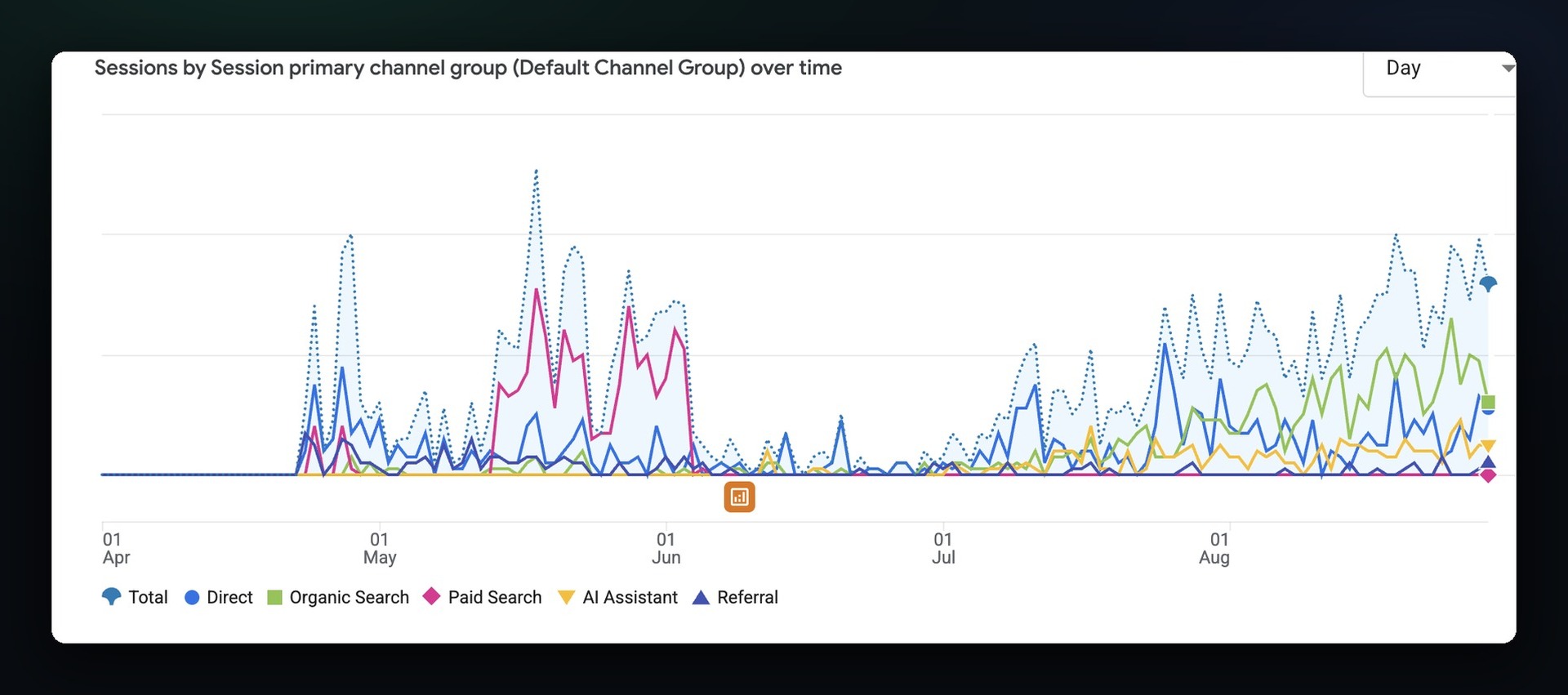 Acquisition broadened from initial direct traffic to advertising, then to organic search and AI-assisted discovery. The green organic line rises after the paid line has already gone flat.
ListMyCar also published 145 pages answering specific questions about selling a car, including city guides, state title-transfer instructions, marketplace comparisons, bills of sale, and VIN research.
From 22 April through 28 August 2026, Search Console showed 21,200 impressions, 62 clicks, a 0.3% click-through rate, and an average position of 28.6. These are early signals, not proof of product-market fit. They give the team real traffic and behavior to learn from.
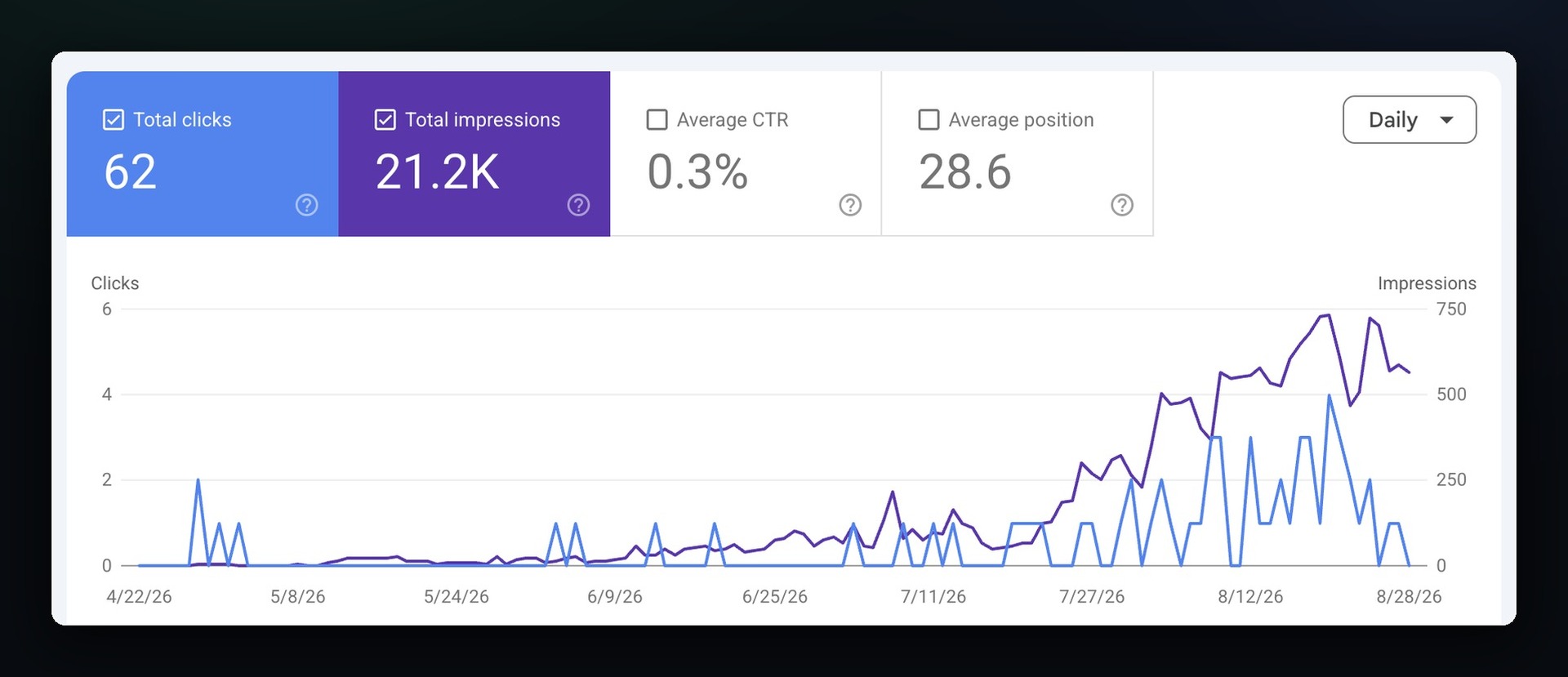 Impressions are the number that moves first: they mean Google has started showing the pages. The curve is flat for two months, then climbs through August. Clicks follow rankings, and rankings follow later.
AEO: precise answers opened another acquisition channel
Answer engine optimization, or AEO, was not a separate launch project. Ahrefs reported 473 AI assistant responses citing 32 ListMyCar pages, including seven AI Overviews. Its visible platform breakdown accounted for 466 responses: 288 in Copilot, 166 in ChatGPT, six in Google's AI Mode, five in Perplexity, and one in Gemini. The snapshot did not attribute the remaining seven. Google Analytics recorded AI assistants as the site's fourth-largest acquisition channel, ahead of referrals.
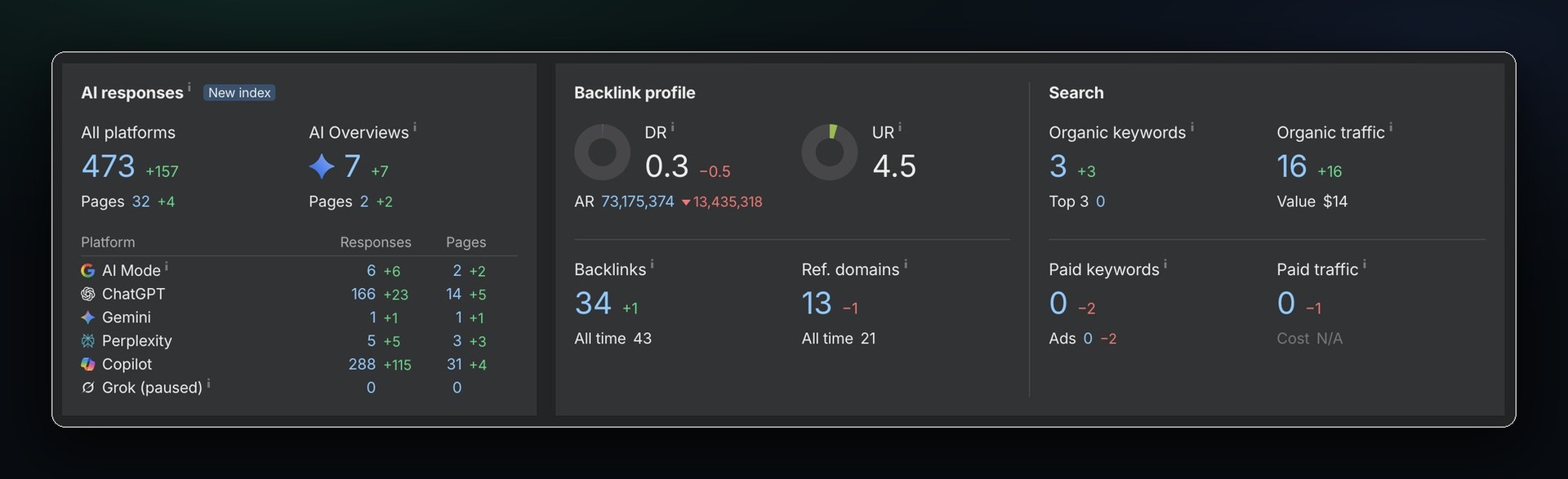 Traditional SEO measures remained low — DR 0.3, three organic keywords, and $14 of estimated traffic value — while Ahrefs reported 473 AI assistant responses.
The cited pages shared a pattern: they answered narrow, practical questions such as title-transfer steps, bill-of-sale requirements, and marketplace comparisons. The lesson is not to manufacture content for answer engines. Instead, publish the clearest useful answer to a real customer question, then make it easy to find and verify.
Turn mistakes into reusable lessons
Completing the work is only half the job. Solo also records what failed, how it was fixed, and whether the fix worked. A repeated production failure gets one stable signature and a verified fix. A green deployment is not enough on its own; Solo also checks the public customer path. Campaign results are compared by region and cohort so the strongest segments can inform the next run.
The same lesson changed ListMyCar's content. Its Atlanta guide answers a local seller's marketplace and Georgia title questions. State guides cover transfer and bill-of-sale requirements. Marketplace guides explain the workflow and trade-offs of a single channel. Instead of publishing more generic articles, the team can deepen the topics that earn discovery and engagement.
Those records already help prevent repeat failures. The next step is to connect each growth suggestion to the result it was supposed to change.
What founders and small teams can reuse
Start with a working foundation that you own. Let developers, coding agents, and Solo share one repository and delivery path. Automate routine work, but require human approval for public, expensive, and destructive actions. Keep evidence with each outcome so the next run starts with evidence from the last.
Bring the idea. Keep your code and tools. Let Solo turn strategy into supervised work and verified learning. Join the waitlist →