Your First 90 Days of SaaS SEO
A practical guide to SaaS SEO: choosing realistic topics for a new domain, publishing useful pages, fixing the technical floor, and measuring progress.
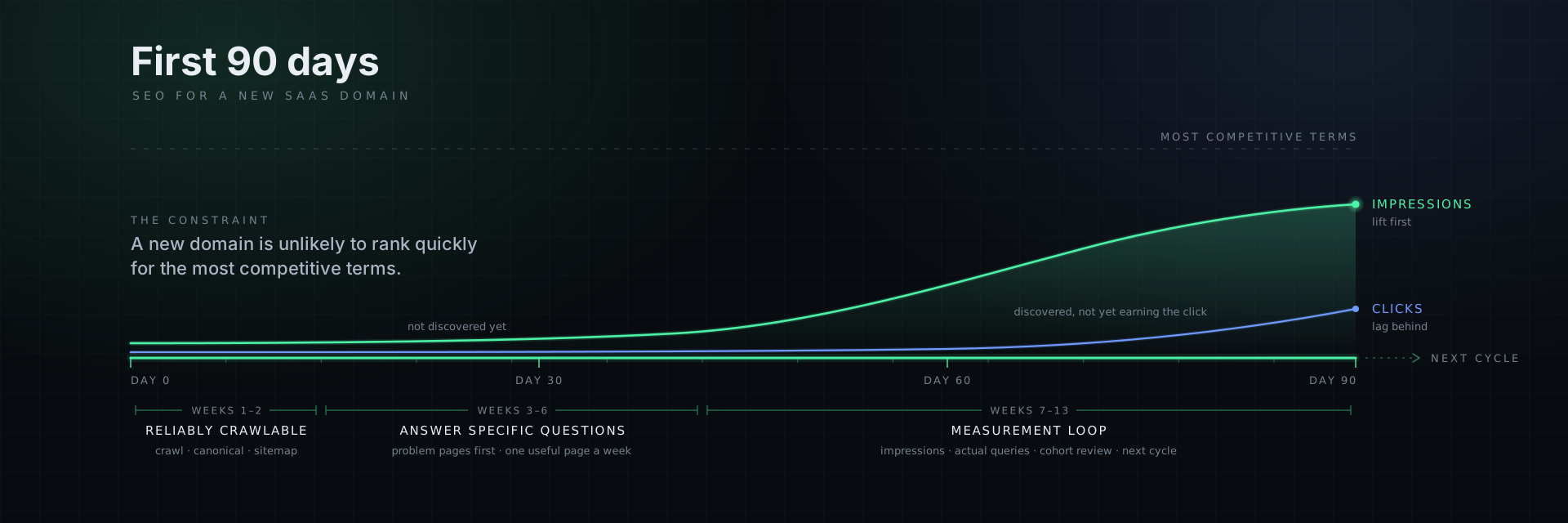
For a new SaaS domain, the first 90 days of SEO should do three things: make the site reliably crawlable, answer specific customer questions better than the current results, and create a measurement loop that tells you what to improve next.
The central constraint is simple: a new domain is unlikely to rank quickly for the most competitive terms. Good writing still matters, but it does not erase authority, relevance, intent, and competition in the short term. This guide turns that constraint into a practical publishing plan for a small team.
Start with the demand you can credibly answer
Third-party SEO tools estimate backlink authority and keyword difficulty on their own scales. Those metrics are not Google ranking factors, and a difficulty score is not a verdict. They are still useful for comparing the relative competition inside one tool.
A new site usually needs a stronger match to a specific query, clearer evidence, or more patience than an established site targeting the same result.
So the first 90 days should focus on specific queries you can answer unusually well, plus the technical and measurement work that lets useful pages be discovered.
As a planning heuristic for a domain starting at zero:
- Difficulty 0–10: inspect first; these are the most plausible early targets
- Difficulty 10–20: consider when the intent fit is strong and the current results are weak
- Difficulty 20+: treat as a longer-term investment unless you have evidence or distribution the score misses
Use difficulty to order your investigation, not to replace it. Inspect the results, confirm the reader is your customer, and choose the query where your product knowledge gives you something better to say.
Keyword research without deceiving yourself
Use search data to challenge your assumptions. A volume estimate is directional, but it is better than choosing a phrase from intuition alone.
Common sources include Ahrefs, Semrush, DataForSEO, and Google Keyword Planner. Their pricing, coverage, and difficulty models differ, so use current provider documentation and avoid mixing scores as though they share one scale. Search Console becomes more valuable once your own site has impressions.
Three traps that cost real time:
Volume that is not your audience. A phrase can have substantial volume while referring to a different industry or problem. Always inspect the actual results before committing.
Phrases too new or narrow to be measured. Keyword databases can lag new language and smooth away small segments. Zero reported volume does not prove zero demand. Check the results, customer conversations, and your own Search Console data.
Intent mismatch. A broad query may mix buyers, practitioners, students, and agencies. Read the current results and decide which reader Google appears to serve. A lower-volume query with a clear problem can be more valuable than a broad category term.
What to publish
Three kinds of page, in this order.
Problem pages. Answer the specific question a customer asks when the problem is active. These queries are often narrower and can offer a clearer path from answer to product.
Comparison pages. Queries such as "X vs Y" and "alternatives to Z" can signal an active decision. Be genuinely fair, disclose the basis for comparison, and name the situations where another product is a better fit.
Category pages. Broad "what is" queries can establish the vocabulary and internal-linking hub for a topic, but they often face stronger competition and weaker buying intent. Publish them when they serve a real reader or support a coherent cluster.
Do not choose category pages only because they have the biggest reported volume. Start where relevance, specificity, and your evidence are strongest.
Depth beats frequency
A common piece of advice is to publish constantly. Small teams are usually better served by a cadence they can sustain without lowering the standard.
The bar is to make the page more useful for its intended reader. That does not mean longest. It usually means concrete steps, supported numbers, original examples or screenshots, and an honest account of tradeoffs, including the ones that do not flatter you.
One genuinely useful page a week can be a strong pace if the team can research, review, distribute, and maintain it.
The technical floor
You don't need a technical SEO consultant. You need these to not be broken:
- Every page returns useful content and links to a crawler. Server-rendering is a dependable default for content pages.
- A valid
sitemap.xmlandrobots.txt, both returning the expected content type. A catch-all route that returns landing-page HTML at those URLs is not a crawler file. - A deliberate host and URL structure. Keep content close to the product unless you have a clear reason to split it across hosts.
- One canonical URL per page. Duplicates compete with each other.
- Fast and stable while loading. Measure the experience rather than assuming the framework made it fast.
- A descriptive title and useful search snippet. Keep both faithful to the page instead of stuffing variations of the keyword.
Then verify the site in Google Search Console and submit the sitemap. Search Console shows how Google discovered and served your pages; third-party tools estimate a different view.
Check that your pages actually load for an anonymous visitor. It's worth curling your own URLs from outside your session: a page that renders perfectly for you while returning a 500 to the world is a failure mode that dashboards don't catch, and it's more common than anyone admits.
AEO: the part that's new
Some discovery now happens through AI-generated answers as well as traditional result pages. A reader may act on a summary without visiting the cited site.
This does not make the fundamentals obsolete. It gives you another reason to make the page easy to understand and verify:
- Answer the question directly, near the top. Buried answers don't get quoted.
- Structure clearly. Real headings, short declarative sentences, lists and tables where they fit. Extractable content gets extracted.
- Be specific and support the claim. Add dates, versions, methods, and primary sources where they matter.
- Keep facts current. An extracted answer can spread a stale claim farther than the original page.
The good news: writing for extraction is largely the same as writing well for humans. The clarity that makes a page quotable makes it useful.
A 90-day operating cadence
No responsible timeline can promise when rankings or traffic will arrive. You can, however, define the work and the evidence you expect to collect:
| Weeks | Work and evidence |
|---|---|
| 1–2 | Fix crawl and canonical issues, map queries to readers, verify Search Console |
| 3–6 | Publish the first focused pages and confirm discovery, rendering, and internal links |
| 7–10 | Review impressions and actual queries; improve pages with mismatched intent or weak coverage |
| 11–13 | Compare the cohort, keep what earned qualified visibility, and plan the next cycle |
Low traffic in the first cycle is not proof that the channel failed. It is a reason to inspect indexation, query fit, quality, and distribution before deciding what to change.
Use the pages beyond search. Send a relevant guide in outreach, link it during onboarding, or use it to answer a recurring support question. That gives the work immediate value while organic discovery develops.
What happened on a new domain
ListMyCar published 145 pages answering narrow questions about selling a car: city guides, state title-transfer instructions, marketplace comparisons, bills of sale, and VIN research. The pages were built around real tasks a private seller might need to complete, rather than one broad attempt to rank for "sell my car."
From 22 April through 28 August 2026, Search Console recorded 21,200 impressions, 62 clicks, a 0.3% click-through rate, and an average position of 28.6. The impressions curve stayed nearly flat for the first two months, then climbed through July and August. That pattern does not prove future growth. It shows why a new-domain program needs enough time and measurement to distinguish "not discovered yet" from "discovered but not earning the click."
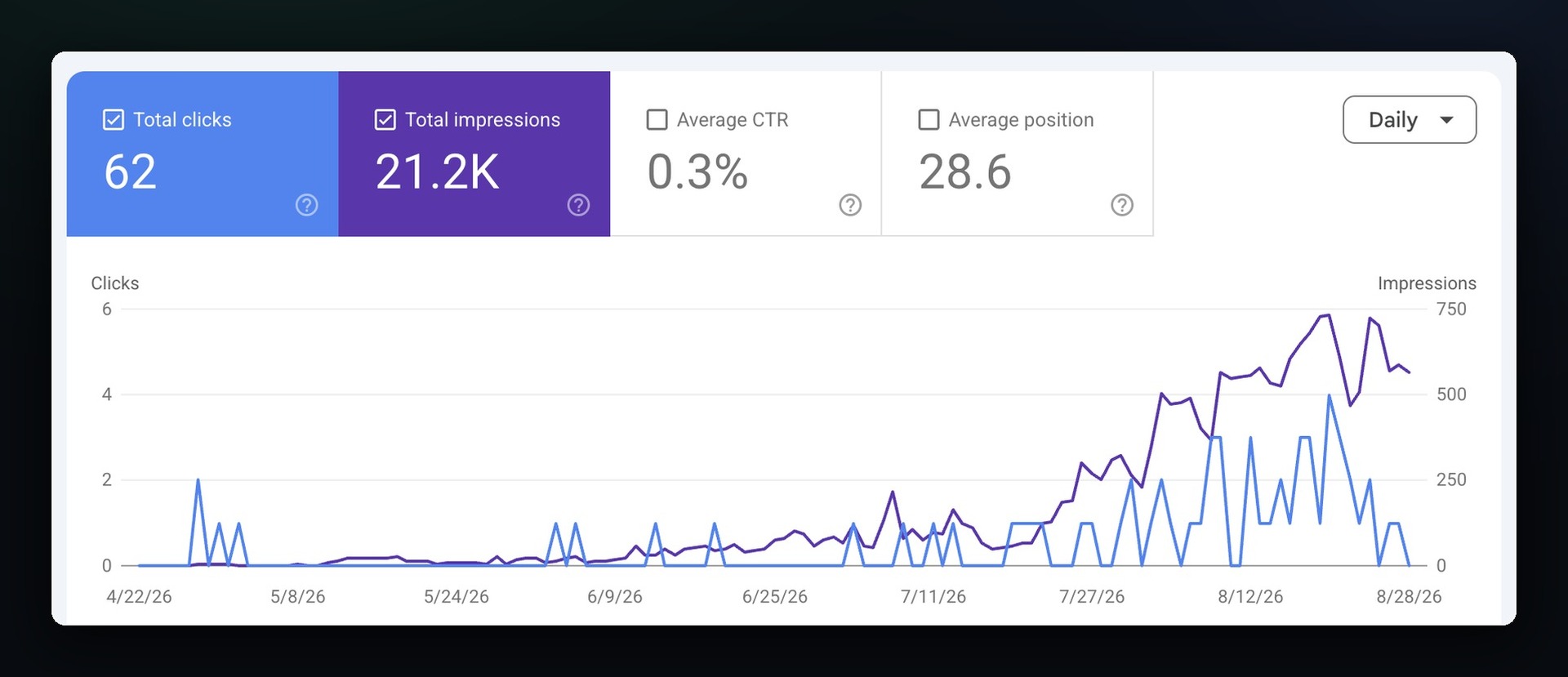 Impressions moved before clicks. That gave the team evidence to improve query fit and search snippets without pretending the first cohort had already won.
Ahrefs also reported 473 AI-assistant responses citing 32 ListMyCar pages, including seven AI Overviews. The cited pages answered precise, practical questions. The transferable lesson is not to produce a separate layer of vague "AI SEO" content. It is to publish an answer that a person can use and another system can parse, verify, and cite.
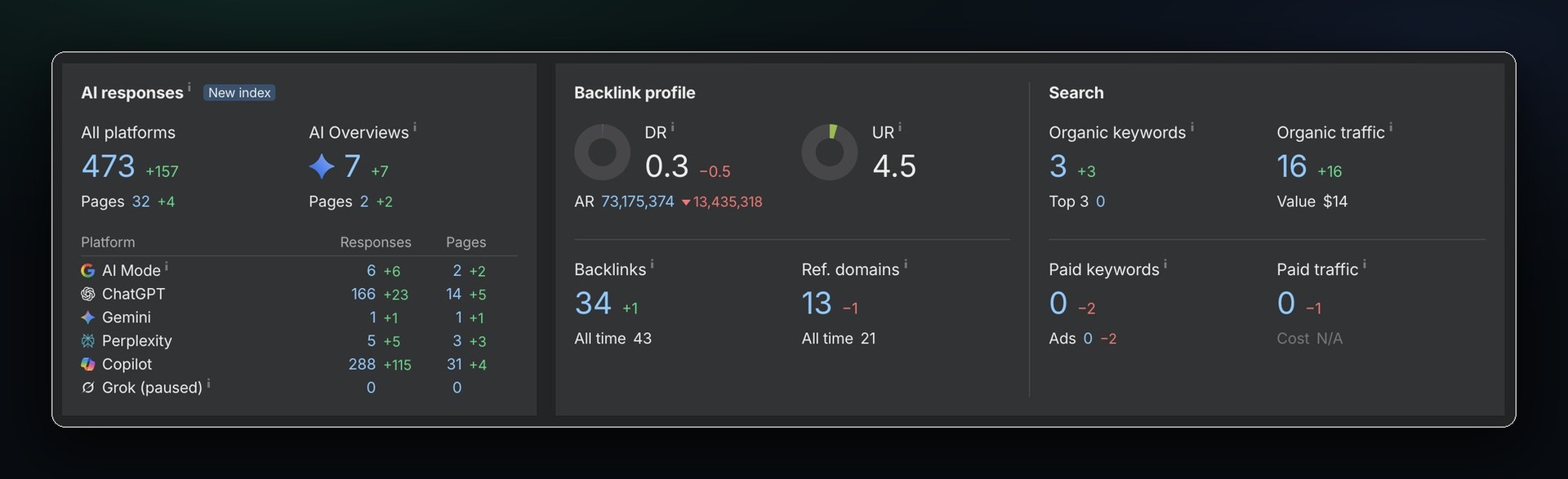 Traditional authority measures remained low while precise ListMyCar pages were already being cited in AI-generated answers.
Read the complete operating story, including the limits of the evidence, in the ListMyCar case study.
Where Solo fits
Solo runs SEO as an operation rather than a one-off project. It researches queries using supplied search evidence, proposes a shortlist, drafts articles, and commits approved work into your repository on a schedule. Publication pauses for human approval.
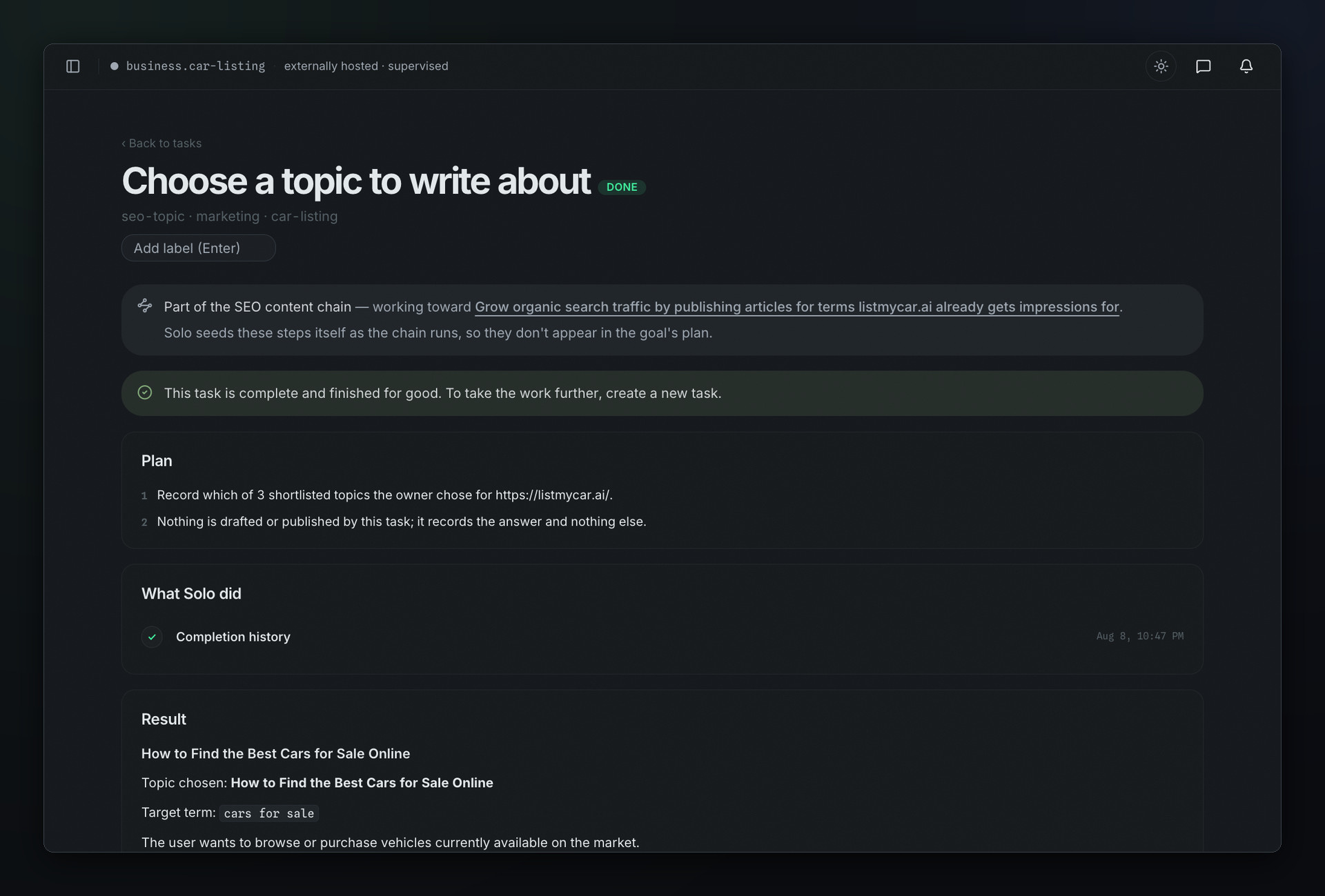 The front of the chain. Solo shortlists topics against supplied search evidence, and this task records which option a human selected. It drafts and publishes nothing.
It is the same pipeline that produced this article and the one used by businesses Solo operates. The value is not merely machine-written copy. It is a retained research, review, publication, and measurement loop that can keep its cadence.
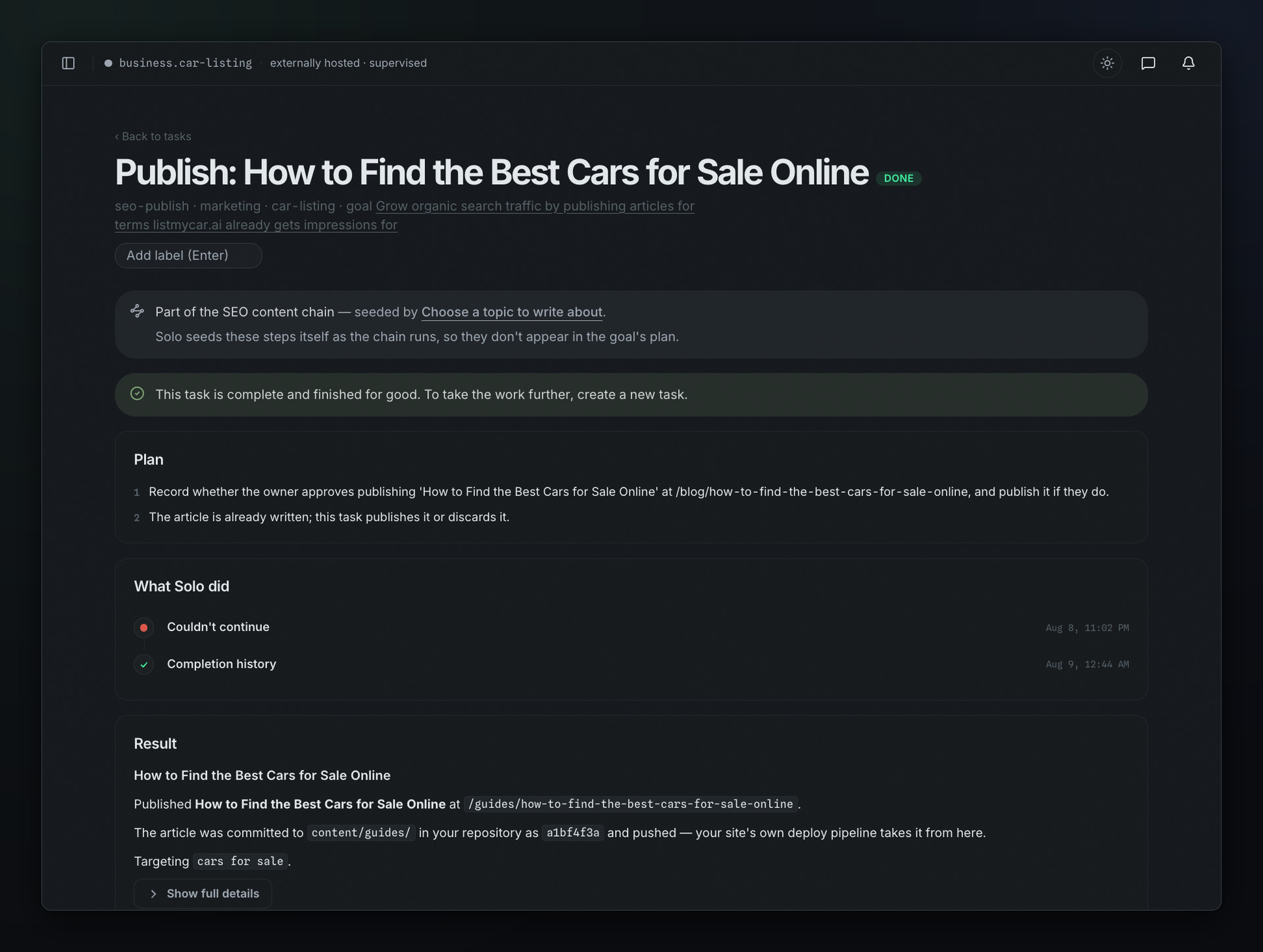 The end of the chain on one of our own sites. After approval, the article was committed and pushed to the site's repository. Its deploy pipeline takes it from there.
SEO needs a loop, not a burst of posts. Solo runs the research, draft, approval, publication, and measurement cadence, while publication remains a human decision. Join the waitlist →