How to Get Your First 25 SaaS Customers Without Ads
A practical customer-acquisition playbook for finding your first 25 SaaS customers by hand, learning why they buy, and separating traction from noise.
There is a specific kind of silence that follows a launch. You shipped, you posted, a few friends said congrats, and then nothing. The analytics show eleven visitors, four of them you.
The way out is rarely a larger launch. Find the first 25 customers one at a time, watch them use the product, and write down what makes them return or leave. At this scale, the conversations are the acquisition system.
Twenty-five is a learning target, not a law. This playbook explains where those customers can come from, what to ask, and what evidence should earn the next investment.
Why 25
Twenty-five is a useful working target, not a universal milestone. The value is in what each range can teach you.
Your first 1 to 10 test whether the problem is painful enough for someone to pay to solve it. These customers often come from people you can reach directly, and every sale is a conversation.
Your first 10 to 25 take you beyond the smallest circle of personal contacts. This is where you start to learn whether there is a repeatable reason people buy or whether each sale depends on a different favour.
Past 25, patterns may start to emerge: which customers stay, what they have in common, and which promise gets their attention. That pattern is what you eventually invest in. Spend heavily before you can describe it and you are buying expensive noise.
The mistake is skipping to the third stage. Founders launch, get four customers, and immediately try to build a growth engine on a sample size of four.
The uncomfortable truth about the first 25
They do not come from scale. They come from you, one at a time, doing things that don't scale and feel faintly embarrassing.
There is no automated funnel at this stage because you don't yet know what to put in it. Every early channel that works has the same shape: you go to where the problem is already being discussed, and you help a specific person.
If that sounds slow, it is. It is often the fastest useful option because ads, SEO, and referral loops all work better once you understand who buys and why.
Where the first 25 actually come from
1. People who already told you the problem exists
If you talked to people while building, go back to them. They described the pain; you built the thing. That is often the shortest path from zero to one.
Don't announce. Ask: "You mentioned spending your Fridays reconciling this by hand. I built something that does it. Want me to set it up for you and you tell me if it's rubbish?"
Some will ignore you, some will decline, and a few may agree. Each response gives you better language for the next conversation.
2. Communities where the problem gets complained about
Find the few places your customer already spends time: a subreddit, Slack or Discord community, forum, industry group, or LinkedIn niche. Skip generic startup communities. You want communities of the people with the problem.
Then, and this is the entire technique: answer questions for weeks without mentioning your product. Be visibly useful. When someone describes exactly the problem you solve, then you say you built something for it. By that point you're a known helpful person, not a drive-by link.
Founders dislike this because it is slow and cannot be scheduled neatly. It can work because useful participation gives the community a reason to trust your eventual recommendation.
3. Direct outreach, done properly
Direct email can work at this stage when the recipient, problem, and message are carefully chosen. A common failure is to describe the product without showing why it matters to this specific person.
The wrong email describes your product. The right email describes their situation, in a way that proves you looked.
A useful structure:
- One line proving you looked at them specifically. Their job posting, their pricing page, a talk they gave.
- One line naming the problem you think they have. Their language, not your feature list.
- One line on the outcome, not the mechanism. "Cuts the Friday reconciliation to about ten minutes."
- A tiny ask. Not a demo. "Worth a look?" or "Want me to send a two-minute video of it on your data?"
Start with a small batch sent by hand to well-chosen people. At 20 messages a day for five weekdays, you will have contacted 100 prospects and learned which assumptions were wrong. Review replies before increasing volume so you do not scale a message that misses the mark.
Two things matter more than clever copy: use an honest sender identity and respect the recipient. Follow up once if you have something useful to add, then stop. Check the consent, identification, and opt-out rules that apply to the places you contact.
4. Being genuinely useful in public
Write the thing you wish had existed when you had the problem. Skip "5 Tips For X." Publish the specific, unusually detailed answer to the exact issue, including the real solution.
This is slow to pay off and worth starting now, because it compounds while you do everything else. It is the seed of the SEO work you'll do properly later; see SEO for SaaS for how that turns into a system.
5. Launch platforms, with correct expectations
Product Hunt, Hacker News, and indie communities can produce a spike of traffic, plenty of casual visitors, and occasionally a few real customers.
Treat a launch as one day of concentrated feedback, not a growth strategy. A launch cannot carry a business by itself. It is more useful when you already have a handful of paying customers and something specific to say.
What does not work yet
Paid ads. At this stage you may not know your message, best-fit customer, or conversion rate. Ads turn those unknowns into a bill. They can make a working funnel bigger, but they can also make a broken funnel more expensive. Come back when you can explain who buys and why. Then read your first ad campaign.
SEO as your only first channel. Useful pages can compound, but early timelines are uncertain and search rarely solves today's zero-customer problem. Start the work now without waiting for it to replace direct conversations.
Virality and referrals. Referral programs need customers to refer. There is nothing to amplify at zero.
A bigger feature list. Building more product can feel safer than asking for a sale. If only eleven people visited and none converted, you do not yet have enough evidence that another feature will help. Get the product in front of more qualified people first.
Converting the conversations you get
Once someone replies, the goal is not a sale. It is to watch them try to use it.
Get on a call. Share screens. Say very little. Watch where they hesitate. That moment tells you what to ask about next. Then set it up for them if you can. At this stage, onboarding by hand is not cheating. It shows you exactly where the product loses people.
Ask for payment when the product is ready to deliver value. Usage, retention, referrals, and payment each reveal something different; together they are stronger evidence than compliments or signups alone.
How to tell traction from noise
Twenty-five customers acquired by hand is genuinely ambiguous. Look for these signals:
- They use it again without a nudge. Early retention is more informative than launch-day signups.
- They tell someone. Unprompted referral at this size is a very strong signal.
- They get annoyed when it breaks. Indifference to an outage means they didn't need it.
- The same sentence keeps closing deals. That sentence is your positioning; write it down.
And the counter-signal: if every sale requires lengthy personal work and a custom deliverable, you may have consulting revenue rather than a repeatable product. That can still be a good business, but it scales differently.
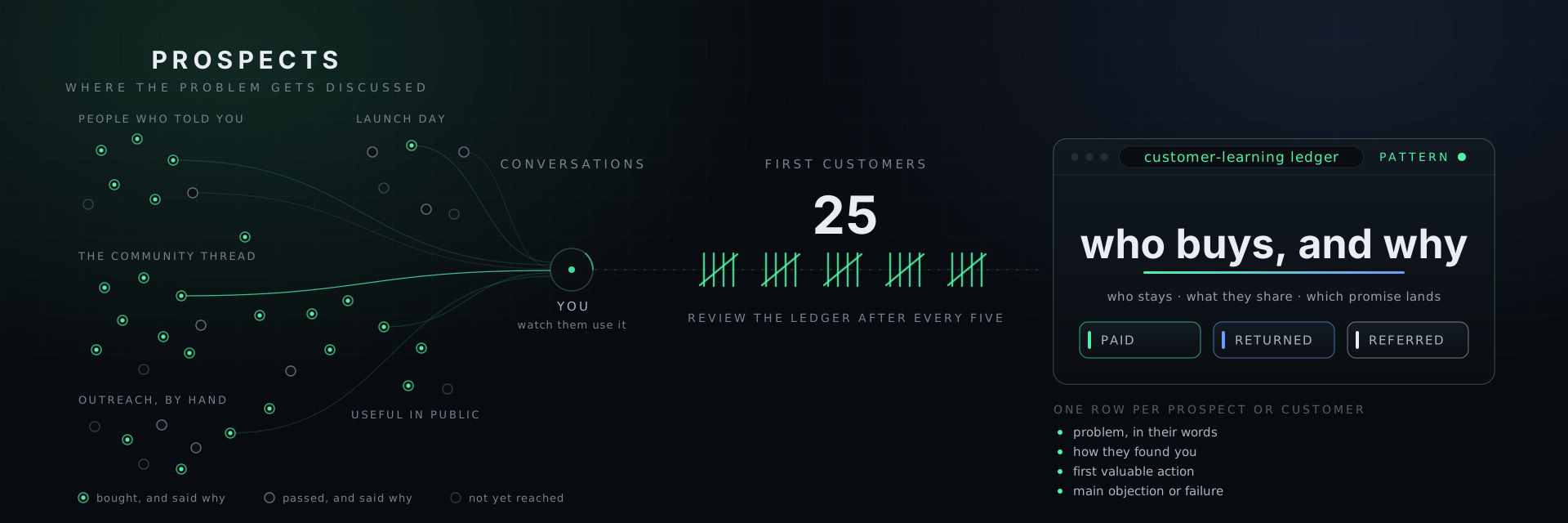
Keep a customer-learning ledger
Do not rely on memory after the call. Keep one row per prospect or customer and record only what will change a decision:
| Record | What it helps you decide |
|---|---|
| Problem in their words | Whether you are hearing one repeated pain or several unrelated ones |
| How they found you | Which channel produced a qualified conversation |
| First valuable action | Where activation actually happens |
| Paid, returned, referred | Whether interest became behavior |
| Main objection or failure | What to fix in the product, message, or targeting |
Review the ledger after every five conversations. Change one assumption at a time, then look for the same pattern in the next five. The purpose is not to make a tiny sample look statistically certain; it is to stop repeating a weak message or onboarding path blindly.
A real example: activity is not traction
From April through August 2026, more than 50 people created a listing on ListMyCar.ai. The site recorded 2,048 sessions and 956 engaged sessions across direct, organic, paid-search, and AI-assistant traffic. Those are useful operating signals, but they do not answer the customer questions by themselves: who returned, who completed the core job, who paid, and why?
That distinction is why the ListMyCar case study calls the results early evidence rather than product-market fit. Traffic tells the team where attention came from. The customer-learning ledger explains which part of that attention is worth earning again.
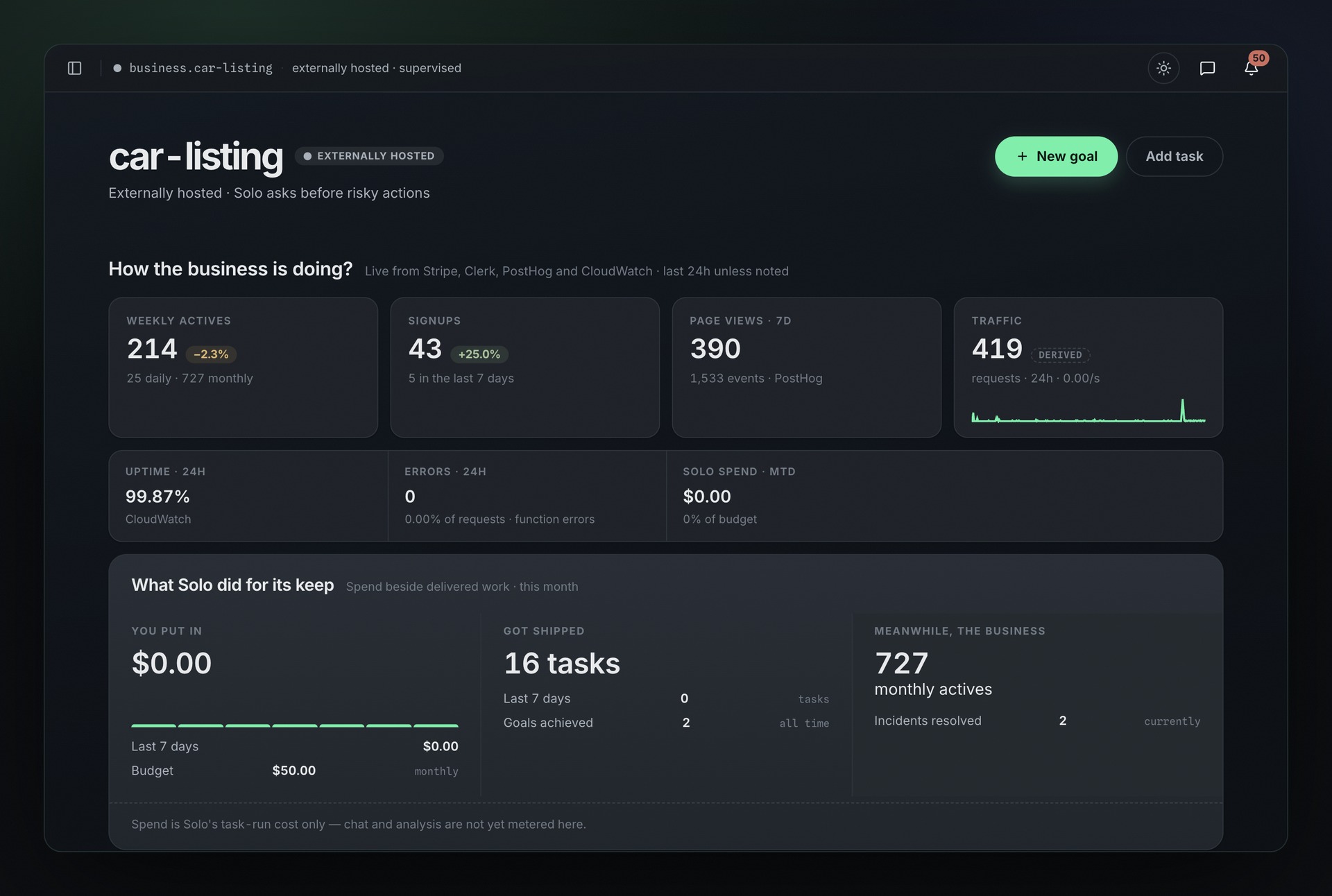 A business view can collect the operating signals, but founders still have to interpret them through customer conversations and behavior.
What this costs you
Time, mostly, and a tolerance for rejection that founders often underestimate. Budget for weeks of consistent, one-at-a-time work, then adjust to your sales cycle and market. A consumer product and a high-touch B2B product will produce very different timelines.
The trap is that this work competes directly with building. Every hour in a community or writing outreach is an hour not shipping features, and shipping features can feel more productive. When the evidence gap is about demand rather than capability, another feature does not close it.
Where Solo fits
Founders often under-invest in this because operating the business keeps eating the available hours. Deploys, incidents, billing edge cases, and maintenance arrive as interruptions during exactly the time you meant to spend talking to customers.
Solo takes that side of the ledger. It scaffolds the business on a production stack and runs monitoring, incident triage, deploys, and scheduled marketing work, with approval at consequential steps. The point is not that it finds customers for you. It gives you more time to do the customer work only you can do.
Your job is the 25 conversations. Solo's job is the recurring operating work around them. Keep the product repo and the decisions; let Solo run the systems that compete for your attention. Join the waitlist →