Google Ads or Meta Ads for Startups? A First-Campaign Guide
How to choose Google or Meta for a startup ad campaign, build a test budget from your economics, track conversions, and avoid wasting early spend.
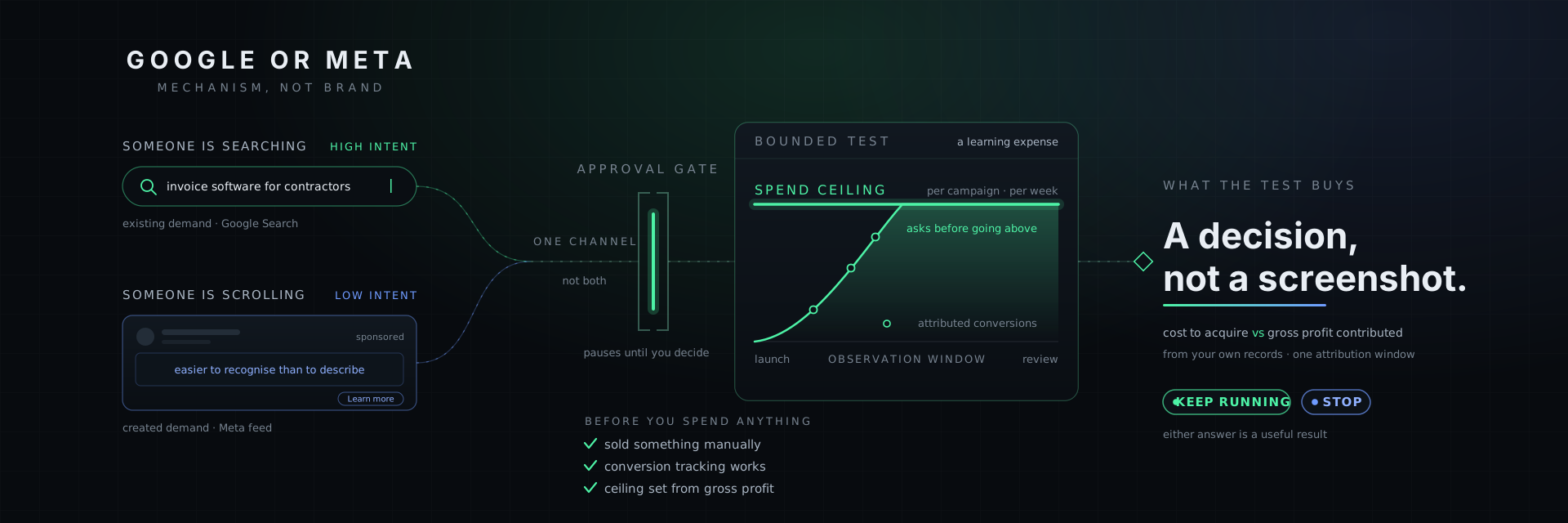
Choose Google when people already search for the problem or category you sell. Consider Meta when the offer is easier to recognize in a feed than to describe in a search. In either case, do not launch until you can track a business outcome and name the most you can afford to pay for it.
Paid advertising can produce traffic immediately, which is exactly what makes an unprepared first campaign expensive. Ads amplify: they make a working funnel bigger and a broken one cost more, faster. This guide turns the first campaign into a bounded learning test.
Before you spend anything
Three preconditions. Skipping any of them turns your campaign into a very slow, very costly A/B test with no control group.
You've sold something manually. You have heard, in customers' words, what makes them say yes. If you have not reached that point, start with the first 25 customers. Ads are an expensive way to discover your message.
Conversion tracking works. You can connect an ad interaction to a meaningful signup or sale. Without that connection, you are likely to optimize for activity instead of business results.
You have an economic ceiling. Estimate the gross profit a customer contributes over the period you can observe, then decide how much of it you are willing to spend on acquisition. Revenue alone is not enough because delivery, support, refunds, and payment fees still have to be paid.
Google or Meta?
They are different mechanisms, not competing brands.
Google captures existing demand. Someone types "invoice software for contractors." They have the problem right now and are looking for a solution. You pay to be considered. That often means higher intent and a shorter path to purchase.
Meta creates demand. The person is browsing rather than actively searching for your product. The ad has to earn attention, make the problem recognizable, and carry the reader through a longer path to action.
The rule of thumb:
| Meta | ||
|---|---|---|
| Best when | People search for your category | People don't know it exists |
| Intent | High | Low |
| Creative burden | Lower for text ads | Higher for image or video, with regular refreshes |
| Time to first signal | Depends on traffic and conversion volume | Depends on delivery and conversion volume |
| Fails when | Nobody searches for it | Your audience isn't definable by interests |
If people already search for what you sell, consider Google first. Check your category in a keyword tool and inspect the actual results. Meaningful volume for specific problem and category terms suggests demand you may be able to capture.
Consider Meta if your product is visual, consumer-facing, or solves a problem people do not yet know how to name in a search.
Don't run both at once. You'll split a small budget into two datasets, neither large enough to learn from.
Build the budget from your own numbers
There is no honest universal minimum. A useful test budget depends on four inputs: expected cost per click, landing-page conversion rate, signup-to-customer rate, and the number of customers needed to judge the result.
For example, if clicks cost $4, 5% of visitors sign up, and 20% of signups become customers, the implied acquisition cost is $400 before creative and tooling. A campaign with a $300 total budget cannot validate that model. It can test whether an ad earns clicks, but not whether the channel acquires customers profitably.
Work backward from the decision you want to make. If the available budget cannot plausibly produce several meaningful conversions, narrow the audience, choose an earlier but still valuable event, or use outreach and content to improve the message first. Treat the first campaign as a learning expense, not promised growth.
Conversion tracking, properly
This is the part that's usually broken, and a campaign with broken tracking is worse than no campaign, because it optimises confidently toward the wrong thing.
What you need:
- A conversion event close to money. Prefer a qualified signup, activated trial, or purchase over a page view. Optimize for the deepest event your traffic volume can support.
- Server-side confirmation where appropriate. Browser-side tracking can lose events to privacy controls and network failures. Use the platform's current server-side or enhanced-conversion option when it fits your consent and data-handling obligations.
- UTM parameters on every ad, retained with the signup or lead where your privacy policy and consent basis allow it. First-party records give you an independent view of attribution.
That last point matters because platforms may use different attribution windows, view-through credit, and modeled conversions. Compare their reports with your own records, document the window you use, and make decisions from one consistent definition.
Structuring the first campaign
On Google, a Search campaign usually gives a first-time advertiser a clearer learning surface than a campaign spread across several Google properties. Start with a few tightly themed ad groups and phrase or exact match keywords. Use a bidding approach that fits the conversion data you actually have.
Write negative keywords before you launch, not after. Build them from the irrelevant meanings you found while researching the query, then inspect the search-terms report frequently during the first two weeks. Add exclusions only when the term is genuinely outside your offer; a generic negative list can remove useful demand as easily as it removes waste.
On Meta, test distinct creative ideas before building a maze of small audiences. Your strongest lever is often the message and creative. Give each variation enough delivery to judge, watch frequency and performance for fatigue, and refresh only when the evidence changes.
Both platforms: send traffic to a purpose-built landing page that matches the ad's promise, not your homepage. Your homepage is a menu; an ad needs a single, continuous message from click to conversion.
The five ways beginners burn money
- Optimising for the wrong event. Tell the platform that page views are conversions and it will find you an endless supply of people who view pages and never buy.
- Broad match with smart bidding, too early. The default settings, together, will spend your budget on loosely related searches while it "learns". Start narrow.
- Judging too soon, or fiddling daily. Frequent changes make it hard to tell what caused the result and can disrupt platform learning. Set a review cadence before launch and intervene early only for broken tracking, policy problems, or spend outside your guardrails.
- Sending everyone to the homepage. A visitor who clicked an ad about a specific problem should land on that problem.
- No landing-page conversion work. A better conversion rate can reduce acquisition cost without buying more traffic. Review message match, speed, proof, friction, and mobile usability before endlessly tuning bids.
What ListMyCar's paid-search test could—and could not—prove
ListMyCar's traffic from April through August 2026 included 380 sessions from paid search. The acquisition chart shows a paid-search spike across May and June, followed by an organic-search curve that continued rising after the paid line had gone flat.
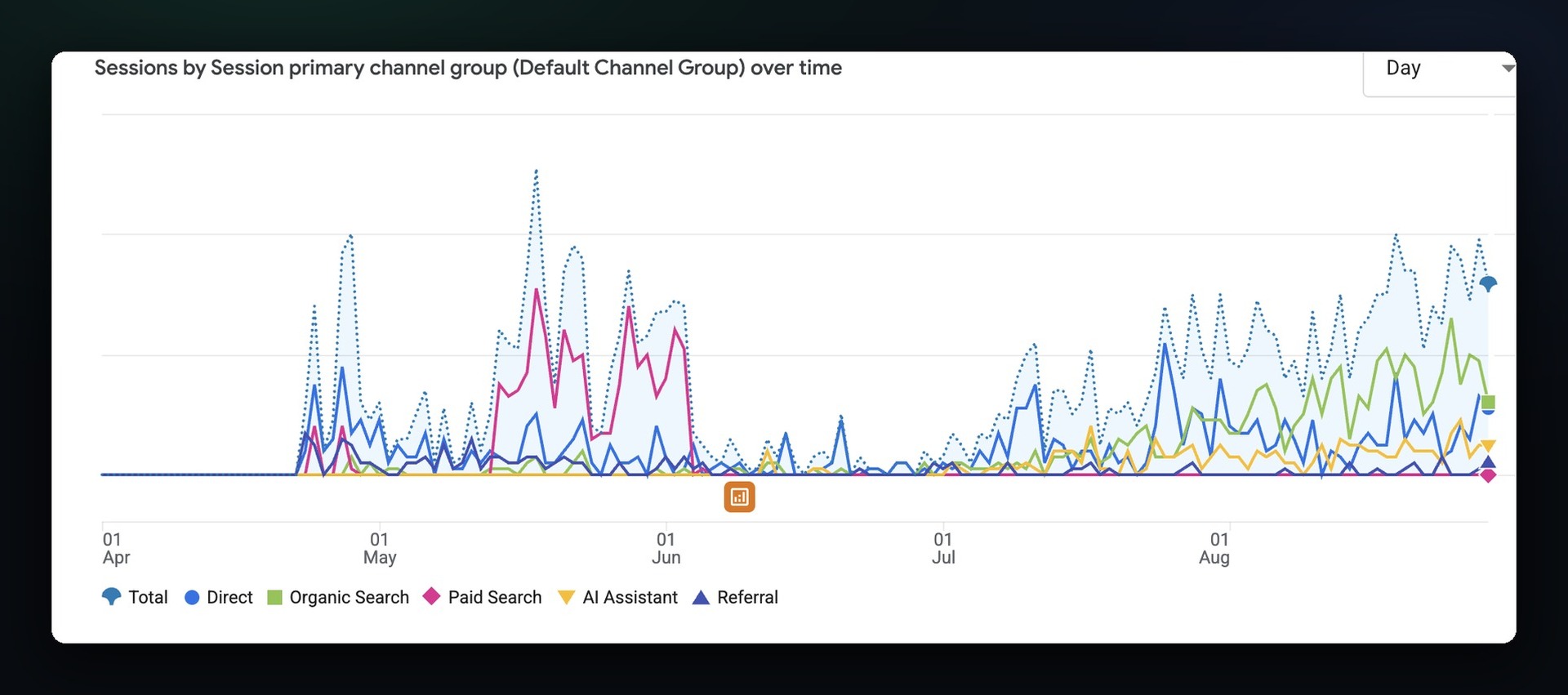 The channels did different jobs at different times: paid search created an early burst of visits, while organic discovery developed later.
That is enough evidence to describe traffic timing. It is not enough to call the campaign profitable. The snapshot does not supply campaign spend, attributable customers, gross profit, or payback. A responsible review keeps those questions open instead of turning a visible spike into a success story.
The reusable campaign record is therefore more than the ad-platform dashboard. Keep the approved audience and message, spend ceiling, exposure window, attributed conversion definition, customer outcome, and stop rule together. Then the next test can start from a decision rather than a screenshot. The ListMyCar case study shows how that evidence sits alongside the rest of the business.
Knowing whether it worked
The central comparison is cost to acquire a customer versus the gross profit that customer contributes. Include media, creative, tooling, and sales work in the acquisition side. Use a payback window your cash flow can support rather than borrowing a universal ratio from another business.
Set the observation window from your sales cycle before launch. Then be willing to conclude that the channel, audience, or offer does not work at the current economics. That is a useful result. Plenty of good businesses grow through search, outreach, partnerships, or word of mouth instead.
Where Solo fits
Ads are an operational commitment, not a launch. Someone has to check the search terms report, rotate fatigued creative, watch the cost per acquisition drift, and pause the thing when it stops paying. That's a weekly job that competes with building your product, and it's usually the first job to get quietly dropped.
Solo runs ads as a scheduled operation: campaign planning, build, launch, and ongoing monitoring, with approval gates at the points where money is committed. You approve the strategy and the spend; the recurring work of watching and adjusting runs without you. And because it also runs your analytics, the cost per acquisition it reports comes from your own database rather than the ad platform's self-assessment.
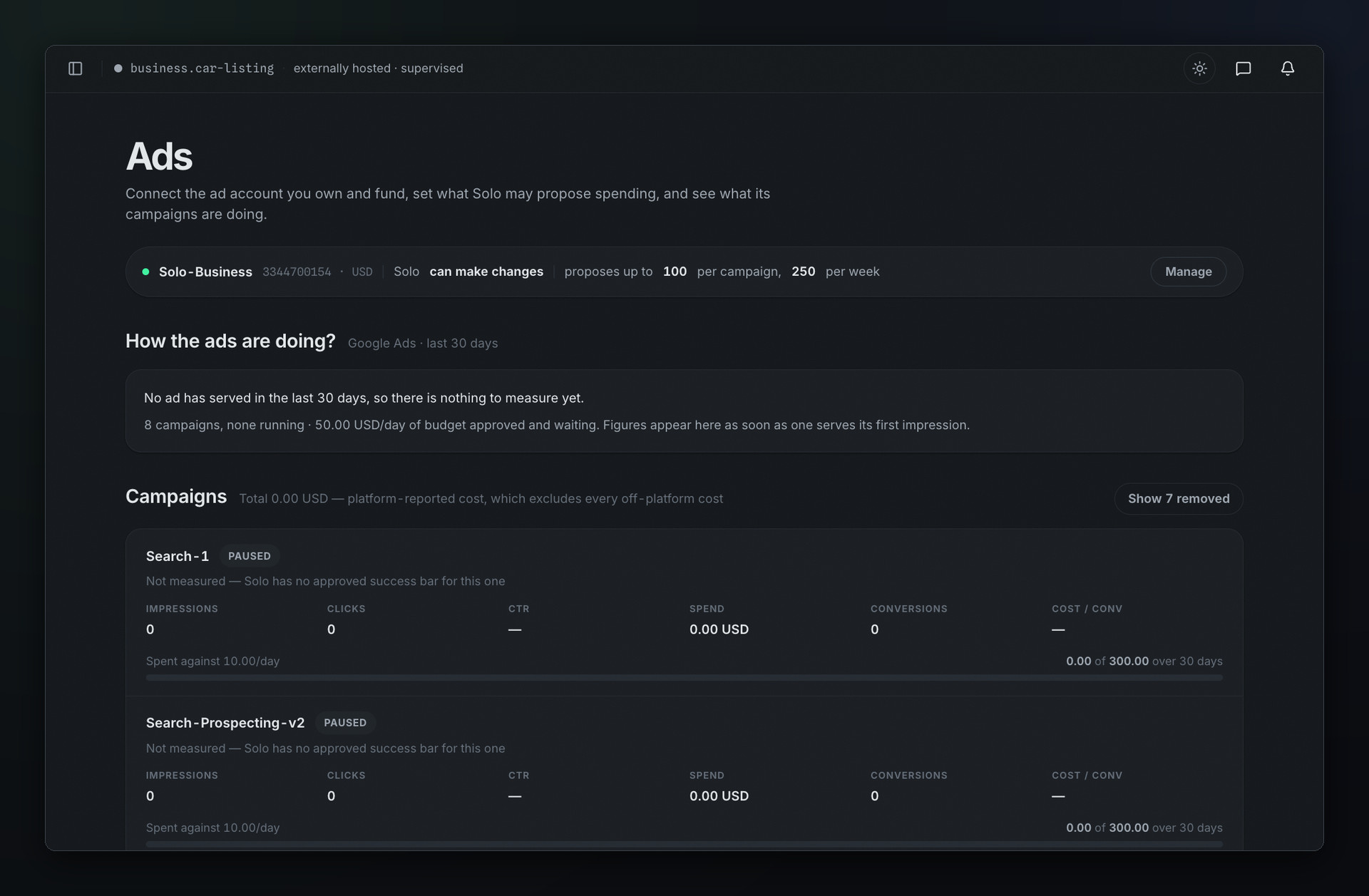 The ad account stays yours and you fund it directly. Solo operates within a cap per campaign and per week, then asks before going above it.
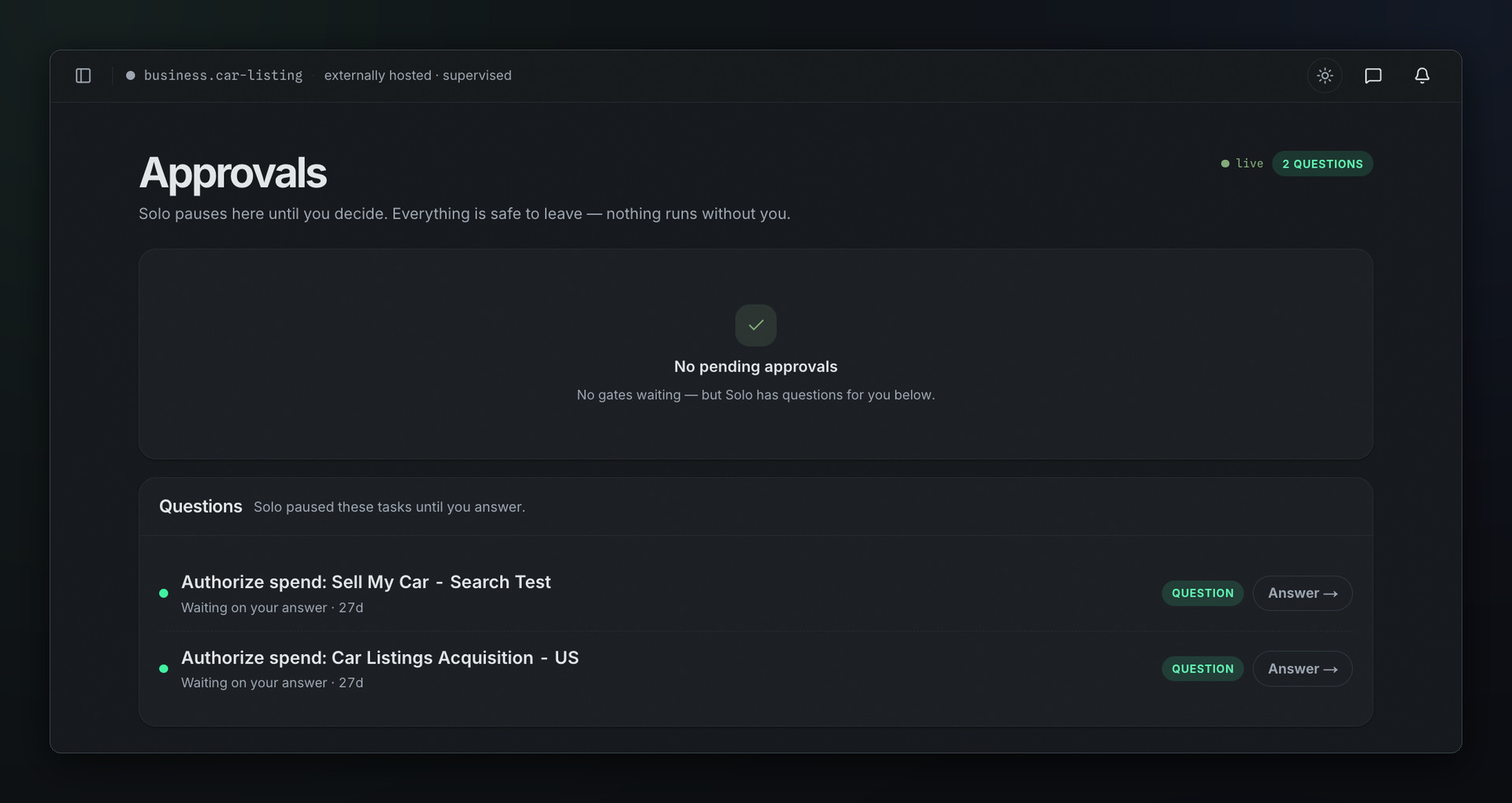 When Solo asks, it stops. Both campaigns are waiting for a human to authorise the spend before money moves.
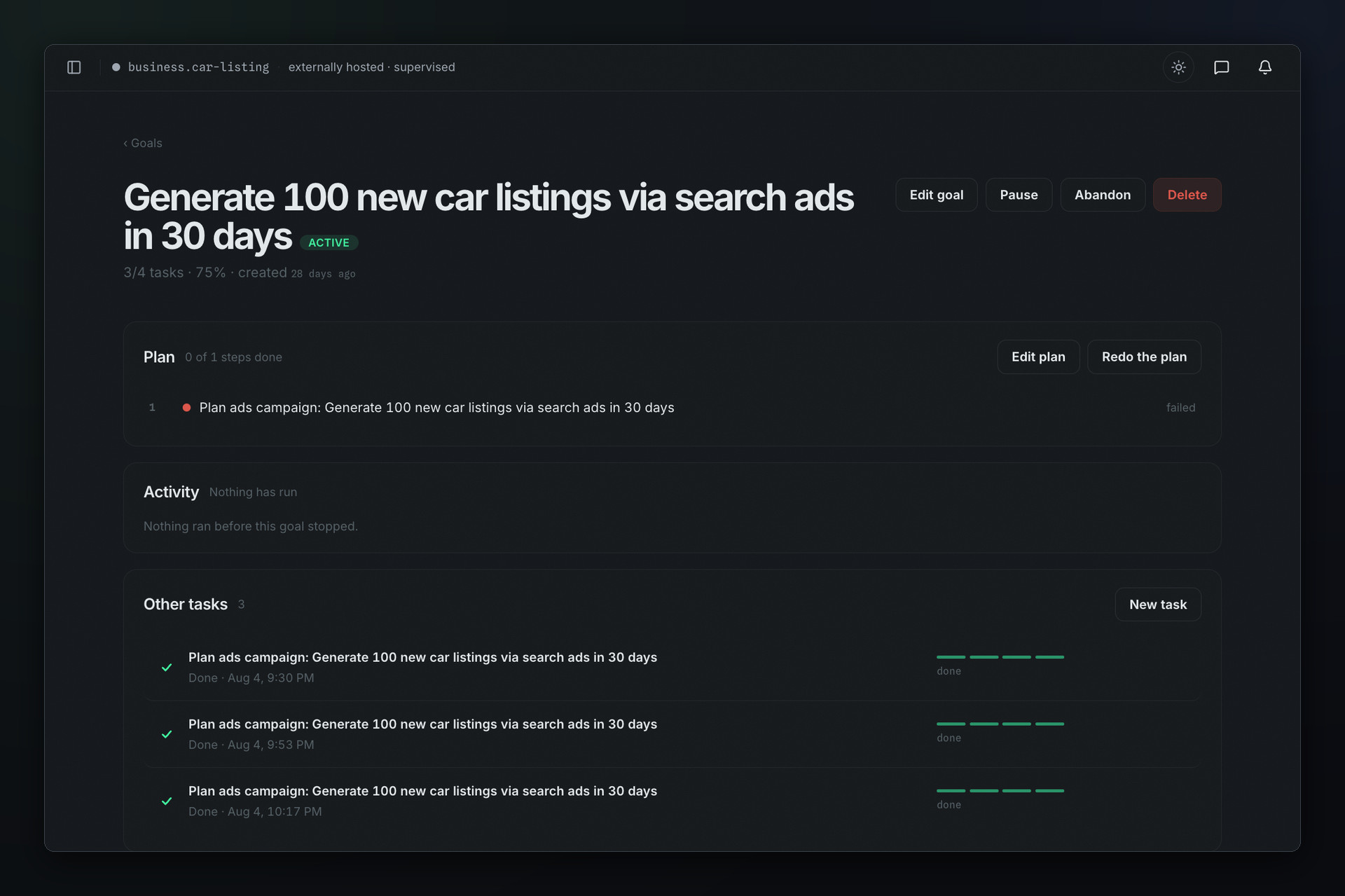 The campaign starts with a goal stated in business terms, which Solo turns into a plan and then into tasks. This plan keeps its failed step visible because it is a record of what happened, not a polished report.
Launching is the start. Operating the campaign is the work. Solo runs the recurring ads workflow and stops for approval before spend is committed. Join the waitlist →